He needed a support-desk dataset for a test, and none of the 125 templates fit closely enough. The old options were both unappealing: hand-write CREATE TABLE statements and the semantic detail for a fixture he would discard in a week, or bend a template that did not quite match. Then he remembered CrossRow takes plain English. He typed two sentences and had a reviewable plan a minute later.
Step 1 · Describe it
Say what you need, concretely
He opened Custom Schema and wrote it out. The trick, he found, was being specific about relationships, because the more you say about how values relate, the more of it CrossRow can enforce.
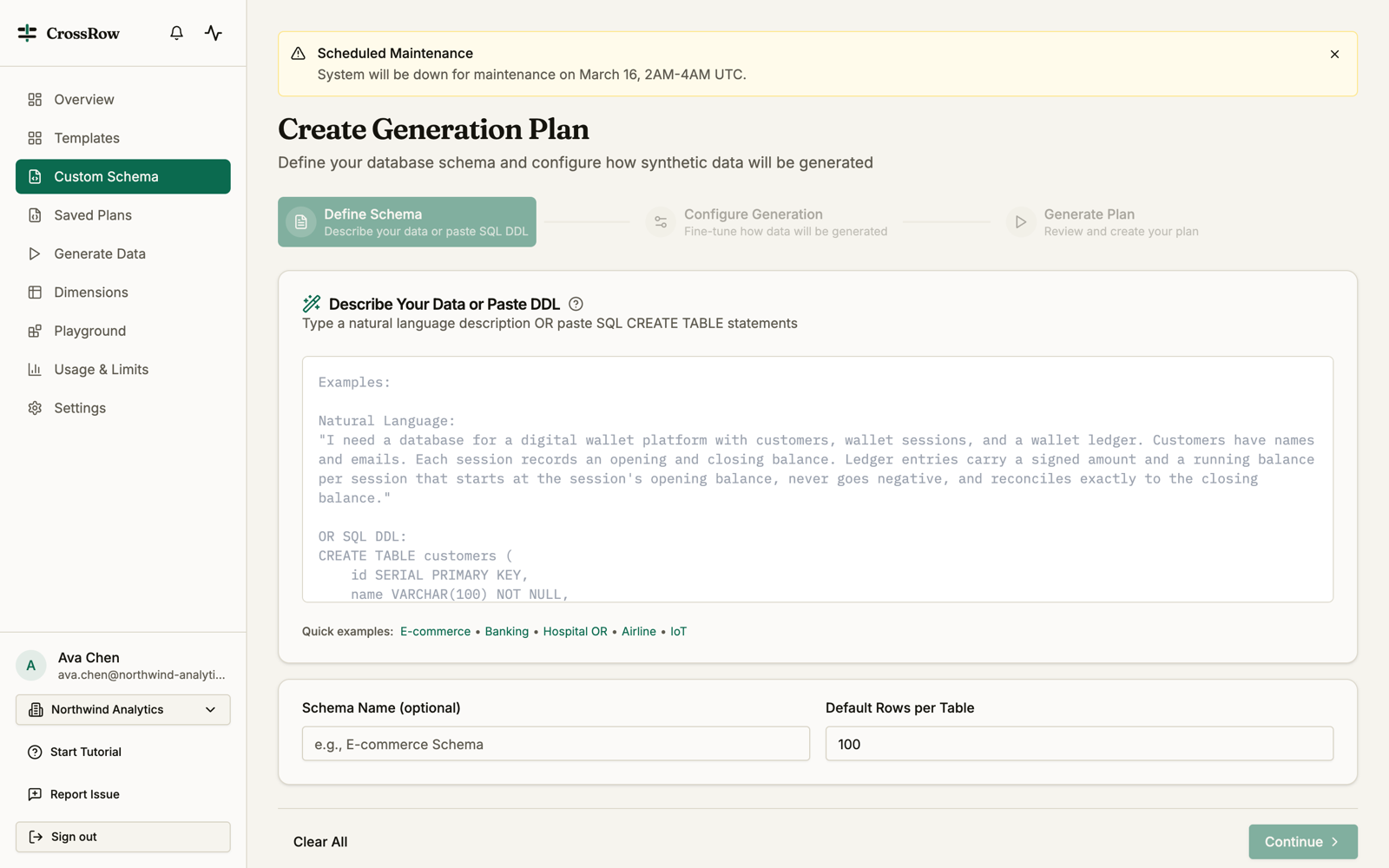
What he typed was close to: "a support desk with customers, tickets, and messages; each ticket belongs to a customer and has a priority that is mostly low; messages belong to a ticket and alternate between the customer and an agent." That was enough for CrossRow to draft the three tables, weight the priority toward low, and order the messages as a back-and-forth instead of a random pile.
Step 2 · Let it plan
Semantic analysis fills in what you left implicit
CrossRow inferred a type and a generation strategy for every column he had not spelled out: which fields were keys, which were timestamps that needed to move forward, which depended on another column. Anything that looked contradictory got flagged before generation. The three-step wizard carried him from that description through configuration to a finished plan without a line of DDL.
Step 3 · From here it is any other plan
Same review, same guarantees
The plan he landed on was indistinguishable from one started from a template: per-column sources he could inspect, hints and rules he could add, generation straight to S3, and a scored quality report at the end. The only difference was where the schema came from. It came from a sentence.
Describing data in English is the fastest route to a bespoke dataset, and it is forgiving by design. You can start vague, read back what CrossRow inferred, and tighten the description or drop in a hint wherever it guessed differently than you meant. The plan is a draft you refine, not a black box you accept. He shipped his test that afternoon.